Dumpster or Junk Removal for a Shed Demo?
Trying to decide between dumpster rental and full-service junk removal for a shed or small building demo? Here’s how we help you choose the right option.
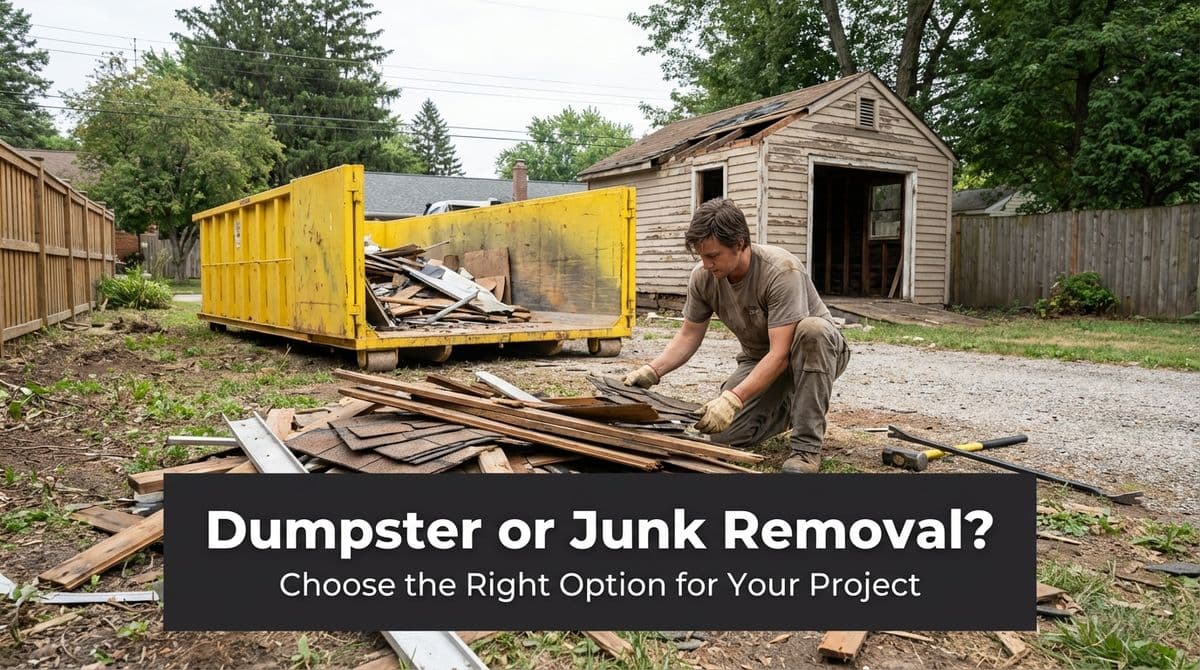
Dumpster Rental vs. Full-Service Junk Removal: What We Recommended
We recently got a call from a homeowner — we’ll call her Carol — who had a great question. She was planning to take down the end of an old shed with a small attached room, about the size of a typical living room. Her question for us was simple:
“Should we just rent a dumpster and do this ourselves, or would full-service junk removal and demo make more sense?”
We walked her through the same thought process we’re going to share with you here. If you’re looking at a shed or small building demo and trying to decide between a dumpster and full-service junk removal, this breakdown will help you choose the right option for your project, budget, and timeline.
How Dumpster Rental Works (Using Carol’s Project as an Example)
For Carol’s area, we explained our typical pricing for construction and demolition debris:
- 12-yard dumpster: $425 with up to 6 tons of debris
- 20-yard dumpster: $525 with up to 7 tons of debris
- 30-yard dumpster: $700 with up to 8 tons of debris
We deliver the dumpster, set it where it’s convenient and safe, and you get up to 10 days to fill it. When you’re done, we come back, haul it away, and dump it once. If you need another dumpster, it’s simply the same price for a second swap.
In Carol’s case, a partial shed and small room demo would likely fit in a 12- or 20-yard dumpster, depending on how much material was inside that add-on room and how the shed was built.
When Dumpster Rental Is the Better Choice
Based on our experience, dumpster rental is usually the right fit when:
- You’re comfortable with DIY demo and cleanup.
- You have time to work — up to 10 days with our rentals.
- You want to control the pace of the project and maybe work evenings or weekends.
- You have help available (friends, family, or a small crew).
- You’re watching the budget and don’t mind putting in elbow grease to save money.
For a shed or small building, a dumpster often gives you the most disposal capacity for the lowest cost, as long as you’re doing the labor yourselves.
How Full-Service Junk Removal & Demo Works
Carol also asked about full-service junk removal — where we handle the demo, cleanup, and hauling. For that type of work, we explained that we really need photos and basic measurements to give a realistic estimate. Sometimes we can price from photos, but an in-person look is the most accurate, especially if:
- There are hidden piles of debris or items inside the structure
- The building is unstable or close to other structures
- Access for equipment or trucks is tight
With full-service, our crew comes out, safely takes down what you want removed, loads everything up, and hauls it away. You don’t lift a finger other than pointing to what needs to go.
When Full-Service Junk Removal Is the Better Choice
We usually recommend full-service demo and removal when:
- You’re short on time and need the job done quickly.
- You’re not comfortable with demolition or heavy lifting.
- The structure is unsafe or partially collapsed.
- There are a lot of contents inside (old furniture, junk, appliances, etc.).
- You’d rather pay for convenience than spend several days doing it yourself.
For some clients, especially those with health issues, limited help, or tight schedules, full-service is absolutely worth it.
Cost Comparison: Dumpster vs. Full-Service for a Shed Demo
Without sharing Carol’s actual quote, we can walk through some typical scenarios we see for projects like hers.
When a Dumpster Is Usually Cheaper
For a basic shed or small add-on room demo where you do the work, a 12- or 20-yard dumpster is often the lowest-cost option. For example:
- Small wood shed, minimal contents → often fits in a 12-yard dumpster.
- Larger shed plus a small attached room → may need a 20-yard dumpster.
If you stay under the included tonnage, your costs are generally limited to that flat dumpster fee. The tradeoff is your time, tools, and labor.
When Full-Service Can Make More Sense Financially
Full-service starts to make more sense when:
- You’d need multiple dumpsters due to volume or heavy debris.
- The structure is complex, and you’d have to hire help anyway.
- You’d lose income taking days off work to do the demo yourself.
In those cases, paying a professional crew to complete the project in a day or two may not be that much more than doing it yourself — especially when you factor in your own time and possible tool rentals.
DIY Demo Safety Checklist for Sheds & Small Buildings
When we talked with Carol, we also reminded her that if she decided to go the dumpster/DIY route, safety needed to come first. Here’s a quick checklist we recommend to any homeowner:
- Protective gear: Sturdy gloves, safety glasses, dust mask or respirator, long sleeves, and steel-toe or heavy boots.
- Power shutoff: Make sure any electrical, gas, or water lines are disconnected and capped by a qualified person.
- Check for hazards: Look for sagging roofs, rot, loose metal, or suspected asbestos/lead paint — call a pro if you’re unsure.
- Work methodically: Remove contents first, then siding/roof materials carefully, then framing.
- Watch your footing: Keep pathways clear, and never stand on rotten boards or unstable surfaces.
- Weather & lighting: Avoid working in high winds, storms, or low light.
If any part of the structure looks unstable, it’s usually safer to have a professional demolition crew handle it.
What Can (and Can’t) Go in a Dumpster?
Another question we often get in calls like Carol’s is, “Can we just throw everything in the dumpster?” The answer is: not quite. Each dump site has its own rules, but here are common guidelines.
Typically Allowed in Construction Dumpsters
- Wood, framing, and trim
- Drywall and plaster
- Roofing shingles and felt
- Windows and doors (without refrigerants)
- Non-hazardous household junk and furniture
- Metal, nails, and fasteners
Commonly Not Allowed or Restricted
- Chemicals, paints, and solvents
- Oil, gasoline, and other flammables
- Asbestos-containing materials
- Refrigerators, freezers, or AC units with refrigerant (special handling needed)
- Tires and certain electronics (varies by area)
When in doubt, we always encourage customers to ask us beforehand. It’s much easier to plan disposal up front than to deal with surprises at the dump.
How We Help You Decide: Dumpster or Full-Service?
At the end of our call with Carol, we told her we’d be happy to look at photos and measurements of that shed add-on and give her realistic options. We also let her know we were a couple of weeks out on demo work — which wasn’t a problem for her since the building had been standing for years and there was no rush.
If you’re in a similar situation — facing a shed, small building, or add-on that needs to go — here’s how we typically help:
- Talk through your project size, timeline, and budget.
- Review photos or schedule a quick site visit if needed.
- Give you a clear comparison between dumpster rental and full-service demo/removal for your specific job.
From there, you can choose the option that fits your comfort level, schedule, and budget — and we’ll take care of the rest.