Planning a Demolition? How to Keep Your Dumpsters Moving
We walk through a real demolition call to show how to choose the right dumpster size, budget for multiple hauls, and keep your project moving without delays.
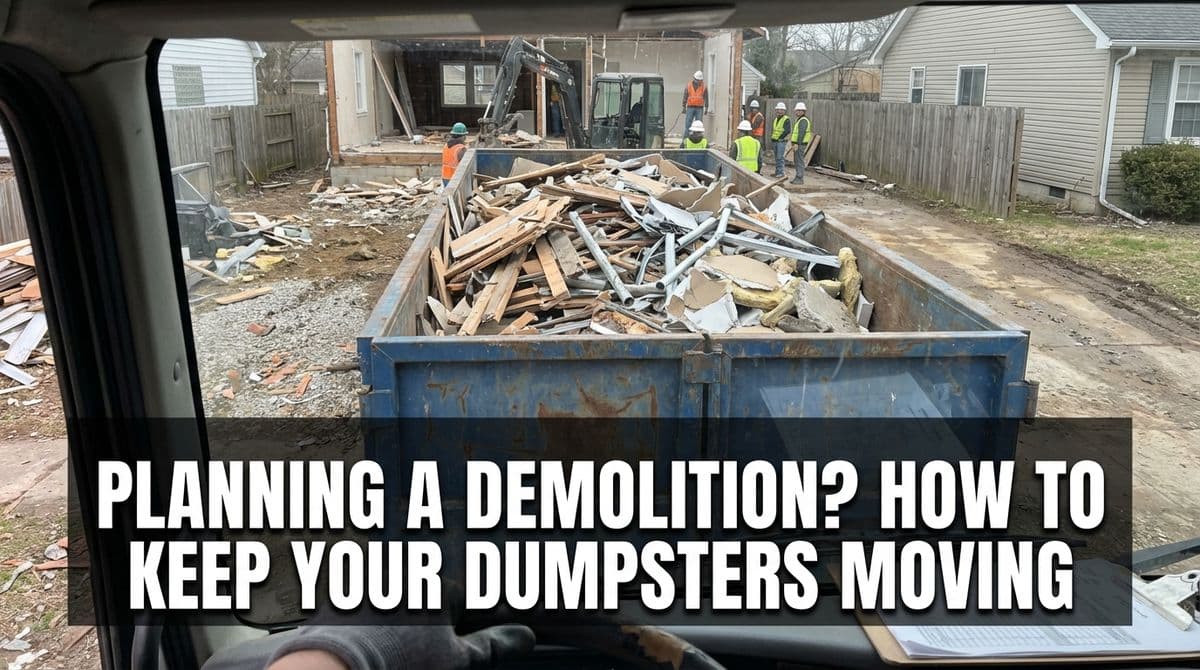
It started with a drive-by and a dilapidated house
We recently got a call from a customer — let's call him Mark — who had just driven past one of our dumpsters in Wears Valley. He'd been meaning to call someone for days about a demolition job in Pigeon Forge, and seeing our container finally made him pick up the phone.
Mark needed to take down an old, dilapidated house and wanted to know three things right away:
- What’s the biggest dumpster size we offer?
- How much would it cost if he needed three or four loads?
- Could we keep up with his pace so he wasn’t sitting around waiting on dumpsters?
Those are exactly the right questions to ask before you start a demolition. So I’ll walk you through how we handled Mark’s project and what you can learn from it for your own job.
Choosing the right dumpster size for demolition
When Mark asked for the biggest dumpster we have, we told him: a 30-yard roll-off. For full-house or large structure demos, that’s usually the sweet spot.
Here’s how 30-yard dumpsters typically line up with different demolition projects:
- Small interior demo (bathroom, small kitchen, a couple of rooms): often 1–2 loads, depending on how much is being removed.
- Garage, shed, or small outbuilding: usually 1 load, sometimes 2 if you’re also tossing old contents and scrap.
- Old single-family home (like Mark’s project): commonly 3–4 loads of a 30-yard dumpster.
Most homeowners worry about over- or under-sizing. A helpful rule of thumb: if you’re tearing down an entire structure down to the foundation, plan for multiple 30-yard loads instead of trying to squeeze everything into something smaller.
Budgeting for multiple dumpster hauls
Mark was upfront that he’d probably need three, maybe four dumpsters. So we talked through pricing clearly. In our service area, a 30-yard roll-off is flat priced per haul. For example, in Sevier County we charge one set price per pickup, and that includes:
- Delivery of the dumpster
- Use of the container for the agreed rental period
- Pickup and disposal
- Tonnage up to a generous weight cap (enough for typical demo jobs)
There are no surprise tonnage fees on standard loads within the limit, which lets you build a straightforward budget: number of estimated loads × flat rate per haul.
For example, if you expect four 30-yard hauls at $700 each, you know you’re looking at about $2,800 for debris removal. That’s the kind of number you can plug directly into a quote for your client or your own project budget.
Weight limits, landfill rules, and what you can’t throw away
Even with a flat-rate structure, most areas have weight limits and landfill rules you need to keep in mind during demolition. Here’s what we always walk customers through:
- Heavy materials like concrete, brick, and dirt can hit weight limits fast. A 30-yard dumpster full of drywall and wood is very different from one full of masonry.
- Hazardous items (paint, chemicals, oils, certain roofing materials, asbestos) usually can’t go in the dumpster at all. They require special handling.
- Appliances and electronics may be restricted or incur extra fees at some landfills. Ask before you toss a pile of them into the bin.
On demolition jobs, we often recommend separating heavy materials like concrete or block into their own smaller loads, or even handling them with a dedicated concrete dumpster if the project is large enough. That keeps you from overloading a container or running into extra charges.
Permits, access, and site conditions
Mark had another important question: his project involved crossing a small bridge to reach the property. He’d had other companies hesitate to go over it, and he wanted to know if that would be a problem.
Situations like this are exactly why we’ll often come out for a site visit before scheduling delivery. For Mark, we set up a time early the next week for one of our drivers to meet him at the property, look at the bridge, the driveway, and the placement area, and make sure we could safely get the dumpster where he needed it.
Before your demolition starts, it’s smart to check:
- Access routes: bridges, tight turns, steep grades, or low power lines.
- Placement space: enough flat, stable area to drop and pick up a 30-yard container.
- Local permits: if the dumpster will sit on a public street or right-of-way, your city or county may require a permit.
Working these details out in advance helps avoid project delays and last-minute scrambling.
How to keep your demolition moving without dumpster delays
Mark’s biggest worry was downtime: “If I load one, how fast can you swap it out?” For demolition work, crews can fill a 30-yard dumpster very quickly, and waiting around for the next one costs real money.
Here are two scheduling strategies we use with demo projects:
- Staggered swaps: You give us a heads-up on your main demo day, and we plan to be in the area for same-day or next-day swaps so you’re not stuck with a full container.
- Two-dumpster rotation: We drop two dumpsters at the start. While you’re filling one, we haul the other. By the time you finish the first, the second is usually back and ready to go again.
For Mark’s old house, we suggested the two-dumpster approach. That way, as we emptied one, his crew could keep loading the other, and the project would keep moving. We do this often with demo companies because no one wants a crew standing around waiting on a truck.
Putting it all together for your own demolition project
If you’re planning a demolition — whether it’s a small outbuilding or an entire house — here’s a quick way to get started on the right foot:
- Estimate the scope: Are you doing interior demo only, or taking a full structure down to the foundation?
- Plan your container size: For full demolitions, expect to use 30-yard dumpsters and multiple hauls.
- Set a realistic haul count: Talk through your project with your dumpster provider and get a ballpark number of loads to build your budget.
- Discuss access and permits: Mention bridges, tight driveways, or street placement so any site visits or permits can be handled ahead of time.
- Schedule for efficiency: Ask about same-day swaps or a two-dumpster rotation to keep your crew productive.
That’s exactly how we approached Mark’s project, and it’s the same process we recommend for any homeowner or contractor getting ready to swing the first hammer. A little planning with your dumpster service up front can save you time, money, and a lot of stress once the demolition starts.